
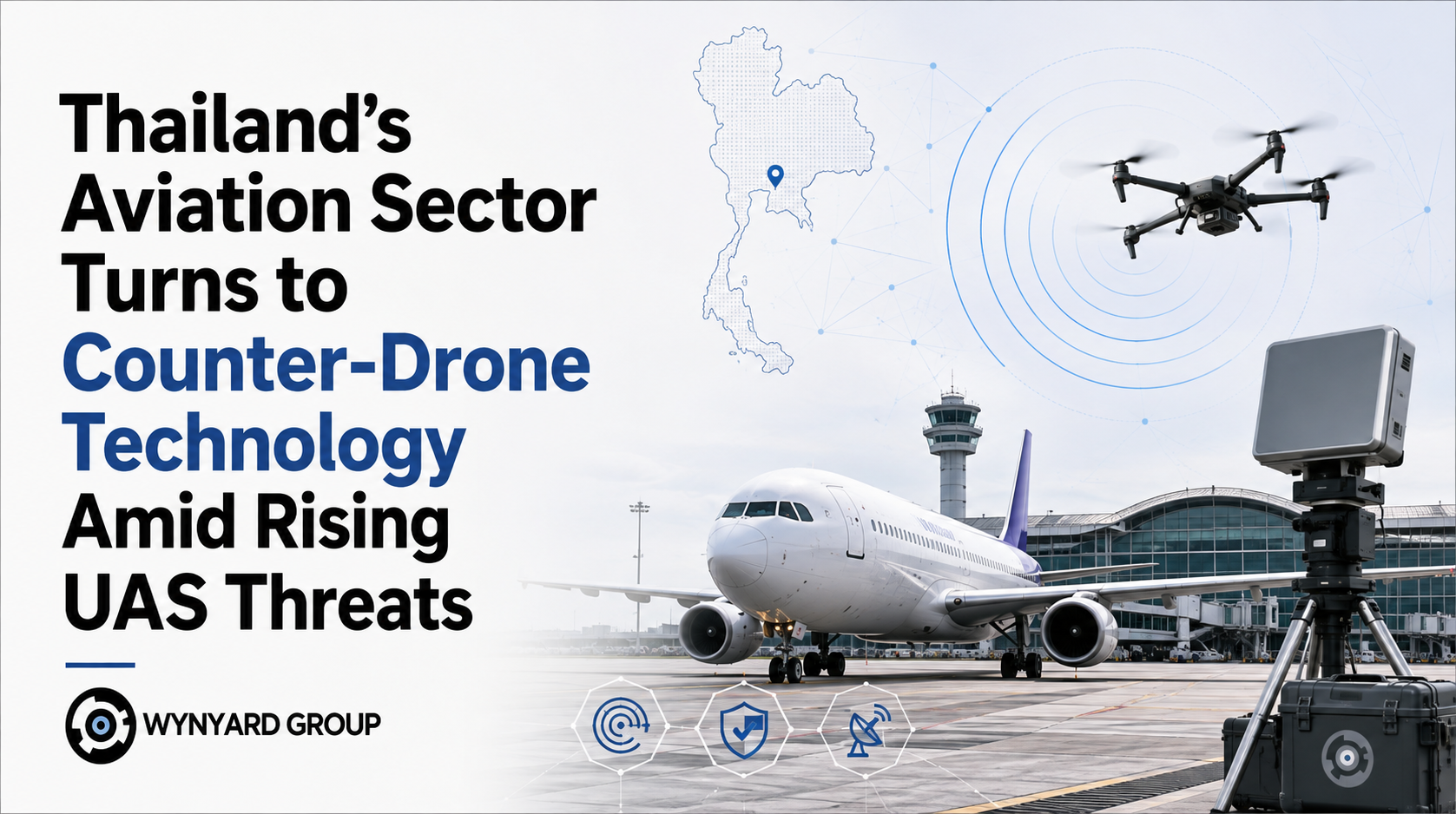
On 3 July 2026, the Civil Aviation Authority of Thailand hosted a Counter-UAS technology briefing at its Bangkok headquarters. The session was led by specialists in radio frequency detection, target tracking, and integrated drone threat management platforms. Air Chief Marshal Manat Chavanaprayoon, Director-General of CAAT, chaired the engagement alongside representatives from the UAS Standards Division. It was a significant signal, not just for Thailand but for the broader Southeast Asian aviation community: regulatory authorities are no longer treating drone threats as a theoretical future problem. They are treating them as a present operational challenge that demands structured technical responses.
Counter drone technology has moved from the defence procurement lists of military agencies into the active planning frameworks of civil aviation authorities, airport operators, and critical infrastructure managers. Understanding why this shift is happening, what it means for aviation security across the region, and what an effective counter-UAS response actually requires is increasingly important for security professionals, policy makers, and technology strategists working in this space.
Why Airports Have Become the Highest-Priority Target for UAS Threat Management
Airports sit at the intersection of the two characteristics that make a location most vulnerable to drone interference: they are safety-critical environments where a single airspace intrusion can ground operations across an entire terminal, and they are surrounded by large open areas that make physical perimeter security insufficient as the primary defence.
A commercial aircraft on final approach travels at speeds where even a small drone strike on an engine or cockpit windscreen can produce consequences that are difficult to manage. A drone near the extended centreline of an active runway does not need to make contact with an aircraft to create an unsafe situation. It simply needs to be present, because the operational response to an unidentified UAS in or near the approach or departure path is to suspend operations until the threat is resolved.
At Suvarnabhumi and Don Mueang International Airports, Thailand’s two primary commercial aviation hubs, runway shutdowns caused by UAS activity would affect hundreds of thousands of passengers across dozens of connecting services. The economic disruption from a single significant incident extends far beyond the immediate airport operation into tourism revenue, logistics schedules, and international carrier confidence in the destination.
The Civil Aviation Authority of Thailand’s engagement with Counter-UAS technology specialists reflects this reality. CAAT is not conducting academic research into potential future threats. It is building the regulatory and technical foundation for a response capability that can be deployed as regional drone activity continues to grow.
The UAS Threat Landscape in Southeast Asia Is More Complex Than Most Accounts Suggest
The popular framing of drone threats in aviation contexts focuses on accidental intrusions by recreational operators who have misjudged restricted zones or lost situational awareness during flight. These incidents are genuinely common and genuinely disruptive, but they represent only one tier of the UAS threat environment that aviation authorities across Southeast Asia are now managing.
Deliberate airspace intrusions, whether for surveillance, smuggling, or disruption, represent a different and more sophisticated threat profile. Criminal networks using drones to carry contraband across borders or into controlled facilities, including airports, have been documented across multiple Southeast Asian jurisdictions. Drones carrying payloads of methamphetamine, documents, or electronic equipment have been intercepted at correctional facilities, military compounds, and border crossing zones in the region.
The drone hardware involved in these operations has also changed. Consumer drones with adequate payload capacity, modified firmware to disable geofencing restrictions, and operating ranges of several kilometres are commercially available at accessible price points. The barrier to deploying a capable drone for deliberate misuse is low, while the barrier to detecting and attributing that deployment has historically been high.
This combination of low operator cost and high defender complexity is what drives the urgency of counter drone technology investment across civil aviation, border security, and critical infrastructure protection.
What Effective Counter-UAS Detection Actually Requires in an Airport Environment
Detecting a drone in or near airport airspace is more technically complex than it might appear, partly because of what must not be triggered falsely in the process. Airport environments contain an enormous volume of radio frequency activity from communication systems, navigation aids, surveillance radar, ground support vehicles, and passenger devices. A counter-UAS detection system deployed in this environment needs to discriminate between all of this background RF activity and the specific signals associated with drone operation, and it needs to do so with extremely low false positive rates.
A false positive in an airport counter-UAS system does not just generate an unnecessary alert. It generates a response, and responses in aviation safety environments consume operational resources and create pressure on decision-makers to suspend normal operations until the threat is assessed. A system that cannot reliably discriminate drone signals from background RF noise will either be configured to suppress alerts to tolerable rates, reducing its actual detection sensitivity, or will create operational paralysis through constant false alarms.
Effective counter drone technology for aviation environments therefore requires a layered detection approach. RF-based detection identifies the radio frequency communications between a drone and its controller. This provides both early warning and the critical intelligence of operator geolocation, allowing enforcement teams to respond not just to the drone but to the person flying it. Radar detection supplements RF monitoring for drones that may be operating autonomously without active RF communications. Electro-optical and infrared sensor integration provides visual confirmation and trajectory tracking that supports operational decision-making. The integration of these sensor modalities into a single operational picture, with automated alert prioritisation and response workflow management, is what defines a genuinely capable system versus a collection of individual detection tools.
From Detection to Response: The Gap That Most Deployments Leave Open
The gap between detecting a drone and resolving the threat is where many counter-UAS deployments encounter their most significant operational challenges. Detection generates an alert. The alert requires human interpretation. Interpretation triggers a response decision. The response decision needs to be implemented through whatever interdiction or mitigation capability is available at the location.
In a civil aviation context, the response options are more constrained than in a military or law enforcement context. Active countermeasures, including jamming or kinetic neutralisation, require regulatory authorisation and operational protocols that account for the potential effects on aviation navigation systems and surrounding civilian infrastructure. This means that the initial response in most civil aviation counter-UAS scenarios involves operational procedures, such as runway suspension and ATC coordination, rather than technical neutralisation of the drone.
This operational response layer needs to be pre-planned, rehearsed, and integrated into the standard incident management procedures of the airport before a detection event occurs. The technology detects the threat. The procedures determine how the organisation responds. Both need to be in place for the capability to be effective, and the connection between them needs to be tested under realistic conditions rather than assumed to function correctly when an actual event occurs.
How Wynyard Group Supports Counter-UAS Situational Awareness
For aviation security organisations working to build effective counter-UAS capabilities, the intelligence and data management layer is as important as the sensor hardware. Detecting a drone generates data. That data needs to be integrated with contextual information about the drone’s trajectory, probable origin point, historical incident patterns, and the operational status of airport airspace at the time of the detection to produce intelligence that is actually actionable.
Wynyard Group works with aviation security, law enforcement, and critical infrastructure protection agencies to build the analytical frameworks that transform detection data into operational intelligence. The integration of counter drone technology sensor outputs with broader situational awareness platforms, incident tracking systems, and threat pattern analysis tools is where Wynyard Group’s capabilities in advanced analytics and intelligence-led operations directly support the counter-UAS mission.
For agencies like CAAT and the regional aviation authorities engaging with counter-UAS technology for the first time, Wynyard Group provides the analytical infrastructure that ensures detection capability translates into genuine operational advantage rather than simply adding another sensor layer to an already complex security environment.
What Thailand’s Engagement with Counter-UAS Technology Signals for the Region
Thailand’s decision to engage formally with Counter-UAS technology specialists at the regulatory authority level is a meaningful indicator of where civil aviation security policy in Southeast Asia is heading. CAAT’s engagement signals that counter-UAS capability is transitioning from an optional enhancement to an expected component of airport security infrastructure, and that regulatory authorities are beginning to develop the standards frameworks that will eventually define what compliant counter-UAS deployment looks like across the region.
Other aviation authorities in ASEAN watching this development are beginning their own assessment processes. The questions being asked are consistent: what detection capability is needed for the specific threat profile of each airport, what response protocols need to be built alongside the technology, how does counter-UAS activity integrate with existing ATC and airport operations management, and what regulatory authorisations are needed for active countermeasures.
These are not questions with simple answers, and the answers will differ across jurisdictions depending on airspace architecture, existing security capabilities, and the specific threat environment each authority is managing. What is common across all of them is the recognition that the UAS threat is real, present, and growing, and that a structured technical and regulatory response is no longer optional.
How Wynyard Group Helps Aviation Authorities Prevent and Manage UAS Incidents
Wynyard Group’s contribution to counter-UAS preparedness extends beyond reactive incident management into the proactive intelligence work that allows aviation authorities to understand the threat environment before an incident occurs. By integrating data from counter drone technology sensor networks with broader intelligence sources, including flight registration databases, known operator profiles, and incident history, Wynyard Group builds the analytical picture that allows authorities to anticipate likely threat vectors, identify high-risk periods and locations, and pre-position response resources accordingly.
This intelligence-led approach to UAS threat management aligns with how Wynyard Group has supported government and critical infrastructure clients across the Asia-Pacific region in managing complex, cross-domain security threats. The counter-UAS domain is new in its specific technology requirements, but the analytical discipline of connecting disparate data sources into actionable operational intelligence is exactly what Wynyard Group has built its capabilities around.
For aviation authorities beginning to build counter-UAS capability, engaging Wynyard Group early in the planning process ensures that the intelligence and data management architecture is designed into the system from the start, rather than retrofitted after deployment reveals gaps that could have been anticipated.
Conclusion
Thailand’s Civil Aviation Authority has taken a concrete and timely step in engaging with counter drone technology specialists to address the growing reality of UAS threats in civil airspace. The July 2026 briefing at CAAT headquarters is not a starting point for a distant future initiative. It is the beginning of a regulatory and technical development process that will define how Thailand’s aviation sector manages unmanned aerial system risks over the coming years.
For aviation authorities, airport operators, and critical infrastructure managers across Southeast Asia watching this development, the message is straightforward: the counter-UAS planning process that would have been valuable five years ago is overdue now. The threat environment does not wait for planning cycles to complete, and the time required to deploy, integrate, and operationalise effective counter drone technology means that organisations beginning the assessment process today will be building capability against a threat that is already present in their operational environment.
Wynyard Group is ready to support aviation security organisations through this process, providing the intelligence infrastructure and analytical capabilities that make counter-UAS technology investments deliver genuine operational value.