
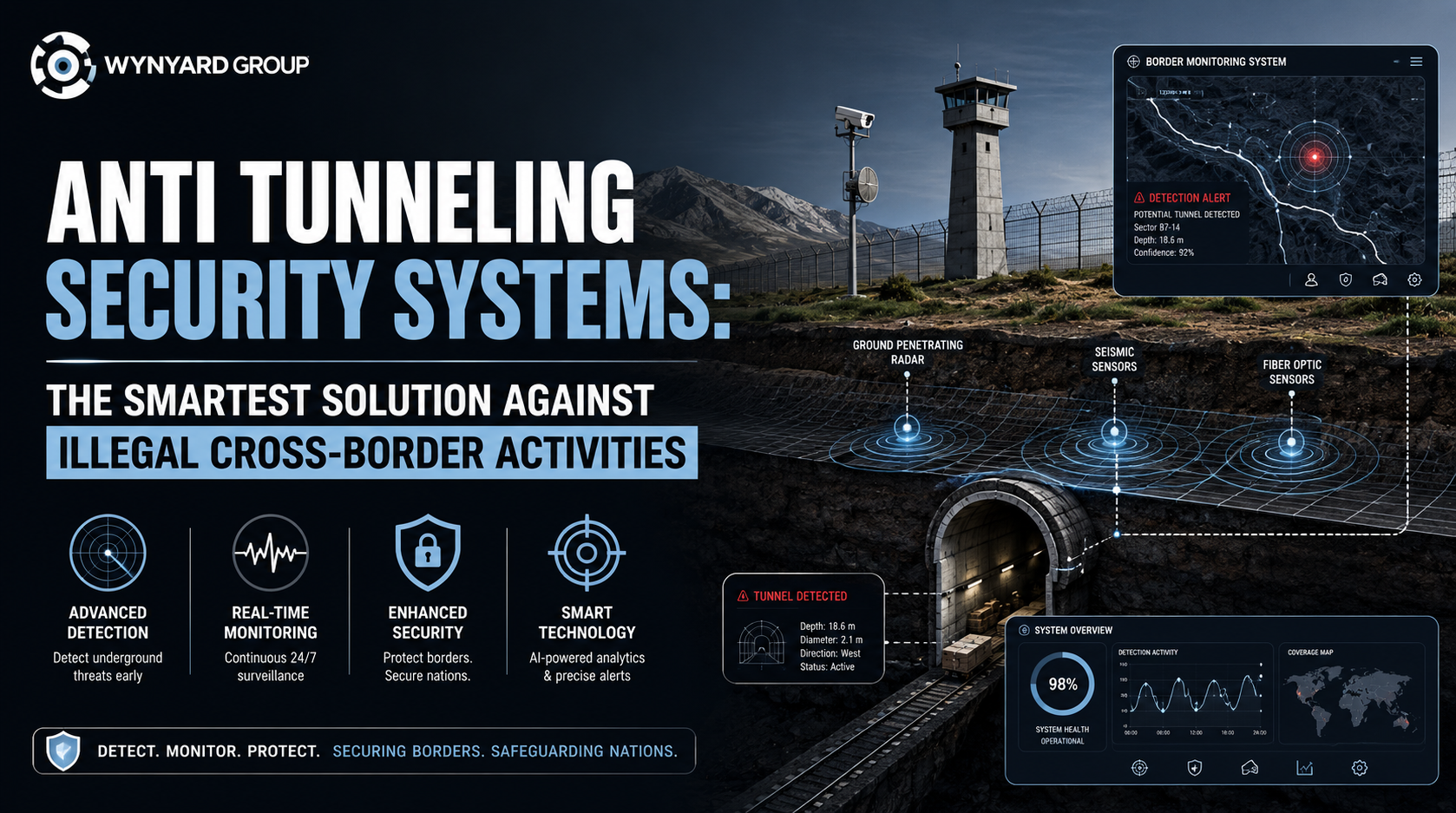
Southeast Asia sits at a geographical and geopolitical intersection, which makes it among the regions with the greatest challenges for border security around the globe. There are more than 25,000 kilometers of borders on land shared by countries like Thailand, Myanmar, Laos, Vietnam, Cambodia, Malaysia, and Indonesia. The scale of transborder activities is staggering. However, not everything is lawful. Underground tunnels are an increasingly documented method used by transnational criminal organizations for smuggling weapons, drugs, and people who are trafficked over borders without being detected.
Security agencies throughout the region are starting to recognise the warnings of forward-thinking defense analysts who have been warning for a long time that physical barriers will not be enough.
Why Tunneling Has Become a Serious Regional Threat
The Golden Triangle, spanning the frontiers that connect Myanmar, Laos, and Thailand, remains among the most active centers for the production of illegal drugs and trade. The criminal networks in this region have, for a long time, made use of weak enforcement zones as well as subterranean routes, which are the most likely next step when the above-ground techniques are under greater scrutiny.
Modern underground tunnels are constructed with concrete, heated, or electrically lit. Certain tunnels are built to move loads at high speed. Others are compact, designed solely for the transportation of highly valuable contraband. For detection, they require specially-designed equipment, not ingenuity.
More than narcotics and tunneling, tunneling has been connected to human trafficking activities across Southeast Asia, particularly in zones bordering conflict, where displacement results in conditions that criminal networks profit from ruthlessly.
What Anti Tunneling Systems Actually Do
Anti Tunneling technology works by sensing subsurface movements that signal excavation. By combining ground-penetrating radars, seismic sensors, and acoustic detection devices, they can detect tunneling efforts before they’re finished, providing security personnel with the information they require to take action.
The most successful installations go beyond the passive method of detection. They provide data to central monitoring systems that enable security personnel to link underground patterns of movement with surface activities, signal anomalies, and historical data on incidents. The sensor’s output is transformed into actionable information rather than sending out isolated alarms.
If Anti Tunneling detection is combined with the wider security infrastructures for border surveillance, such as CCTV networks, drones, and systems for patrol coordination, it creates an enhanced security perimeter that is much more difficult to break through without being detected.
The Function of Crime Software for Investigation in Cross-Border Security
The process of identifying a tunnel is just one aspect of the task. Knowing who created the tunnel, who utilizes it, what is going through it, and the networks it links to is crucial. This is the place where crime investigation software closes the gap between physical security incidents and an effective result for law enforcement.
Agents across Southeast Asia are increasingly turning towards advanced analytics systems, which can handle large amounts of data derived from diverse sources such as customs records, as well as financial transactions, communications intercepts, and incident reports, to find patterns that a human analyst will likely not be able to detect.
Wynyard Group has built its name specifically in this area. Its software for crime analytics is extensively used by law enforcement agencies and border security agencies to spot and deter organised crimes, such as human trafficking, drug trafficking, and smuggling of firearms. It connects disparate pieces of data into coherent threads that enable investigators to shift away from reactive security and anticipate crime network behavior.
The firm has noticed growing requests from agencies of government across Southeast Asia, a region it considers to be a location for organised and transnational crime. This is indicative of a larger change in the way regional security organizations consider the connection with physical border security, as well as technology for digital intelligence.
Why Integration Matters More Than Individual Tools
An error that is often made with regard to border security planning is to treat Anti Tunneling detection and investigative analytics as distinct streams. The value of both is significantly increased when used as integral components of a larger system.
If an alert for tunnel detection is created, it instantly becomes an investigational situation. Are there any criminals operating around the area? Do you see any financial transactions that could indicate the preparation for smuggling? Do the location of the tunnels correspond to trafficking routes that have been identified by prior intelligence? This can be determined in a short time when detection equipment integrates directly into a crime investigation software environment that already has contextual information loaded.
Such a real-time analysis ability isn’t just a goal. All over Southeast Asia, agencies in Indonesia, Malaysia, Thailand, and Vietnam are investing heavily in integrated security solutions that integrate physical detection with the processing of intelligence through digital means. These results can be measured in speedier responses, more robust evidence chains and the disruption of criminal networks on the structural and operational levels.
Building Security Infrastructure That Keeps Pace with Organised Crime
Criminal organizations adjust. They look for security holes, change tactics, then make investments in security measures. A framework based on the use of fixed systems that are not adaptive is likely to be disrupted. The benefit of the combination of Anti-Tunneling detection with advanced crime investigation software is that both produce evidence that boosts performance over time.
Historical detection events inform sensor calibration. The results of investigations feed into behavioral models. The agencies develop a compounding advantage, which makes every investigation better informed as a result.
For decision-makers in security in Southeast Asia, the question is not whether or not to put money into these tools. The question is when these solutions can be implemented to fill the gaps that highly-resourced criminal networks are using. Security agencies that care about their borders are encouraged to investigate the ways Wynyard Group’s range of crime and security solutions could address these operational problems. A good technology that is deployed in the appropriate security framework can transform an inactive border security force into an active one.