
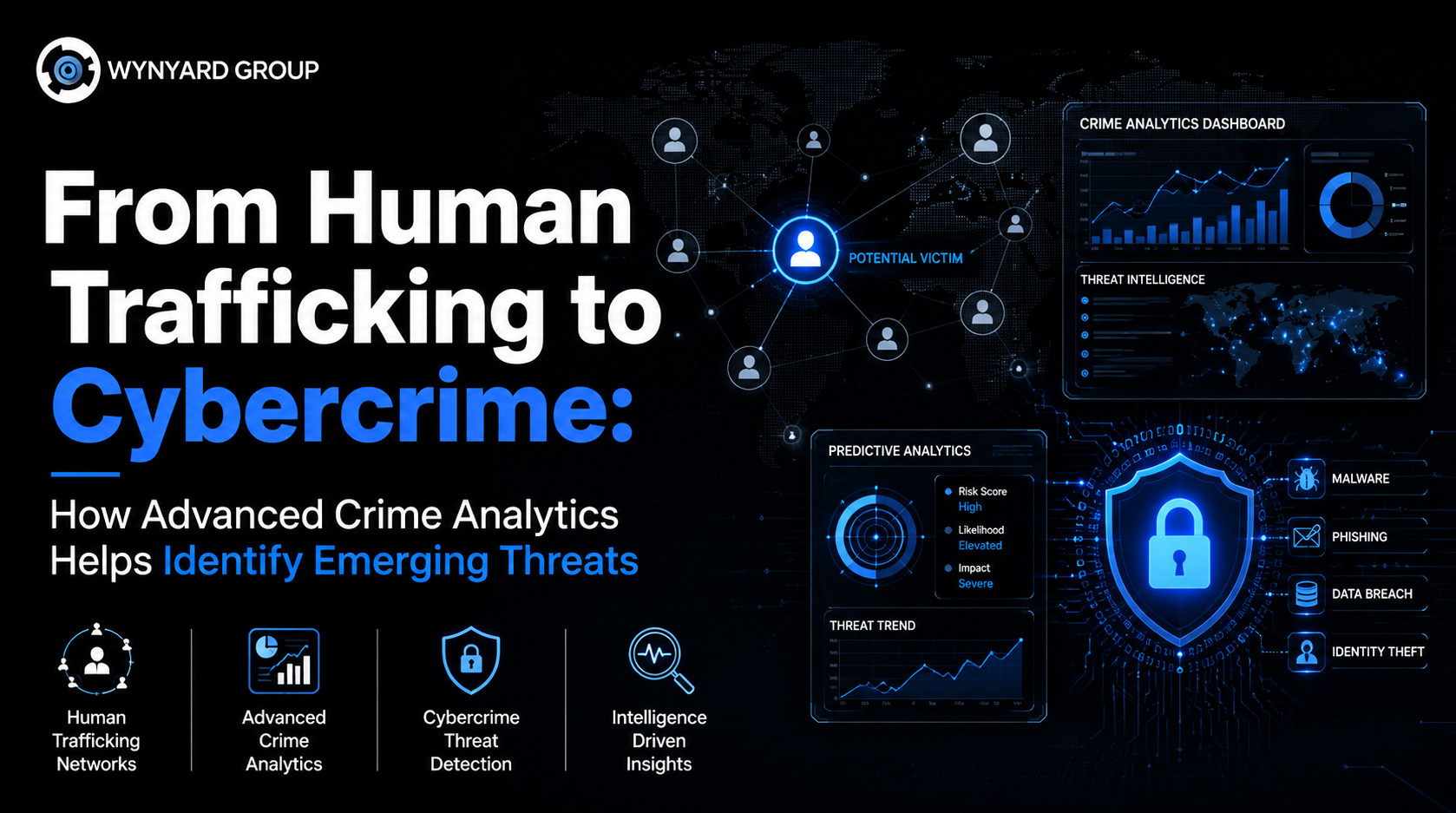
Analytics Helps Identify Emerging Threats
The way serious crimes are committed has drastically changed. Human trafficking networks can recruit victims via social media. Criminals operate ransomware in various jurisdictions using anonymous infrastructure. Fraud-based schemes link forced labor centers within Southeast Asia to cryptocurrency wallets located in Eastern Europe. What’s common between these scams is that they leave behind digital tracks, and those that are properly analysed may expose criminal networks before causing more harm.
Advanced crime analytics has been one of the key tools for police and border security agencies who are striving to remain on top of this growing, complicated issue. This article focuses on the ways in which crime analytics software is utilized across various threat categories and the capabilities that are most important.
Why Traditional Investigative Methods Can No Longer Keep Pace
The majority of the time in the history of police Crime investigation was reacting. A crime was committed, and the evidence was collected as analysts performed a backward analysis to determine the suspects. This model is effective when crimes are contained to a local area. It fails when criminal networks cross areas, utilize encrypted communications, switch between several identities on the internet, and then deliberately hide their financial tracks.
Some of the most prevalent crime types are cybercrime, forced crime, and trans-border trafficking chains, all of which are now more shady and are difficult to spot with conventional enforcement methods. However, there is a cybercriminal landscape heavily influenced by ransomware and data breaches that target crucial infrastructure and fraud driven increasingly by artificial intelligence.
The amount and speed of data generated by these crimes are the main challenges. A single analyst working by hand could process the tens of thousands of transactions in financial markets, compare digital identities, track motion patterns in geospatial space, and flag up abnormalities in behavior simultaneously. This is the operational gap that advanced crime analytics is designed to fill.
The Convergence of Cybercrime and Physical Crime Networks
One of the key findings emerging from the recent investigations into cybercrime is that it’s clear that physical and cybercrime do not have to be separate entities. Criminals who commit investment fraud using cryptocurrency are typically victims of human trafficking from Southeast Asia, forced to run fraud operations. Criminals seek victims via dating apps, social media, and messaging apps before directing them to counterfeit investing platforms.
This is a crucial factor in how agencies organize their approach to analysis. A study that sees the human trafficking issue as a crime of the physical kind and the fraud of cryptocurrency as a digital crime is missing the connections between the two networks. Cybercriminals frequently make use of information and communication technologies to aid in the facilitation of arms, drugs, and human trafficking, the laundering of money, and fraud, which makes the digital infrastructure essential for the vast majority of modern multinational criminal organisations.
The most effective crime analytics software must be able to operate across two domains in tandem, connecting the data from financial transactions, telecom data, digital identity traces, and physical movement patterns to create a single intelligence picture.
What advanced crime analytics Actually Does
The phrase “crime analytics” covers a variety of tools, but none are as effective at identifying new risks. What is most crucial is the distinction between reactive analysis, looking at data following the incident or occurrence, and proactive detection, looking for patterns that indicate that criminal activity is taking place prior to the need for enforcement.
The most important features of crime analytics software include real-time analytics and predictive crime analysis data integration using different sources visualization tools, geographic mapping capabilities, and sophisticated report functions. All that supports better-informed decisions and quicker responses to new threats.
To combat complex transnational risks like cybercrime, organized and human trafficking, the most crucial capability is the fusion of data. Criminal networks tend to disperse their activities across different organizations, jurisdictions, and data systems, knowing that siloed information can reduce the risk of detection. Crime analytics software addresses the issue of siloed data by integrating information that comes from multiple sources, enhancing precision and accuracy, and offering the law enforcement community a full picture of the criminal activity that siloed systems are unable to provide.
Link analysis is the final piece of the puzzle. If crime analytics software maps the relationships between bank accounts, online identities, and even locations, it is able to uncover network patterns that could require human analysts for months to find. A middle-level trafficking coordinator who appears throughout three different investigations, using various names, sharing a telephone number with a well-known fraudster, and then transferring money to an account that is flagged within a linked model. When a siloed database is in place, the person is visible.
Cross-Border Intelligence Sharing: The Coordination Problem
Even the most advanced crime analytics software has an upper limit on its capabilities in that it only has the ability to analyse the data that it has access to. Criminal networks that operate across borders exploit the gaps in jurisdiction, transferring targets, assets, and operations across the border precisely because they are aware of how slow enforcement coordination can be.
Operation Global Chain in June 2025, an important human trafficking eradication that led to the identification of 1,194 possible victims and the detention of 158 suspects in coordinated actions involving 15,000 police officers from 43 countries. This demonstrates both the magnitude of coordination needed and the outcomes the operation can bring.
The operations at this level require a technical infrastructure that lets agencies communicate intelligence in real time, while adhering to legal guidelines regarding the sovereignty of data and privacy. Advanced analytics provide crucial information about border security and assist law enforcement agencies in tackling problems, thanks to AI and machine learning, allowing immediate data analysis to determine areas at risk and efficiently allocate resources.
The companies that have this right put their money not only into instruments for analysis, but also into data governance and interoperability frameworks that allow shared intelligence to be useful rather than just theorized.
Identifying Emerging Threats Before They Scale
The most beneficial application of advanced crime analytics is early detection, which is the process of identifying signs of emerging threats before it grows into a huge-scale operation.
Human traffickers are constantly adjusting to the changing world, new societal advances, and technological developments, and exploiting crises to take advantage of displaced populations. They also benefit from the emergence of technology that allows for mass recruiting of victims.
Crime analytics software supports earlier detection through monitoring of existing indicators across large data sets and flagging clustering patterns that are unusual for kinds of transactions, identifying network structures that look like previously shattered criminal organisations, and tracking criminals who are known to be moving into different operating zones. These indicators are not visible when conducting a traditional investigation case-by-case; however, they become apparent when the data is analyzed and aggregated on a larger scale.
As a Wynyard Group How do we Help?
Wynyard Group delivers advanced crime analytics solutions that help law enforcement and security agencies across Southeast Asia combat cybercrime, human trafficking, fraud, and organized crime. By integrating data from multiple sources and uncovering hidden connections, its technology enables proactive threat detection, cross-border intelligence sharing, and faster investigations. Wynyard Group empowers agencies with actionable insights to identify emerging criminal networks before they can expand and cause greater harm.
Logical Deduction
The dangers police agencies face present a different structure from their counterparts of 10 years earlier. They’re now more interconnected and technologically advanced, and created to take advantage of the gap between the data systems of jurisdictions. Advanced crime analytics gives authorities a means to fill the gaps that exist, not through substituting investigative judgment and ensuring the investigators have the complete picture, not just fragments.
Wynyard Group builds crime analytics software specifically designed for agencies working in this area that provides the data linking, integration, and cross-jurisdictional intelligence for complex threat detection. While criminal networks continue to develop, the organizations most prepared to deal with them are those that invest in analytics infrastructure that can detect the connections that other agencies miss.