
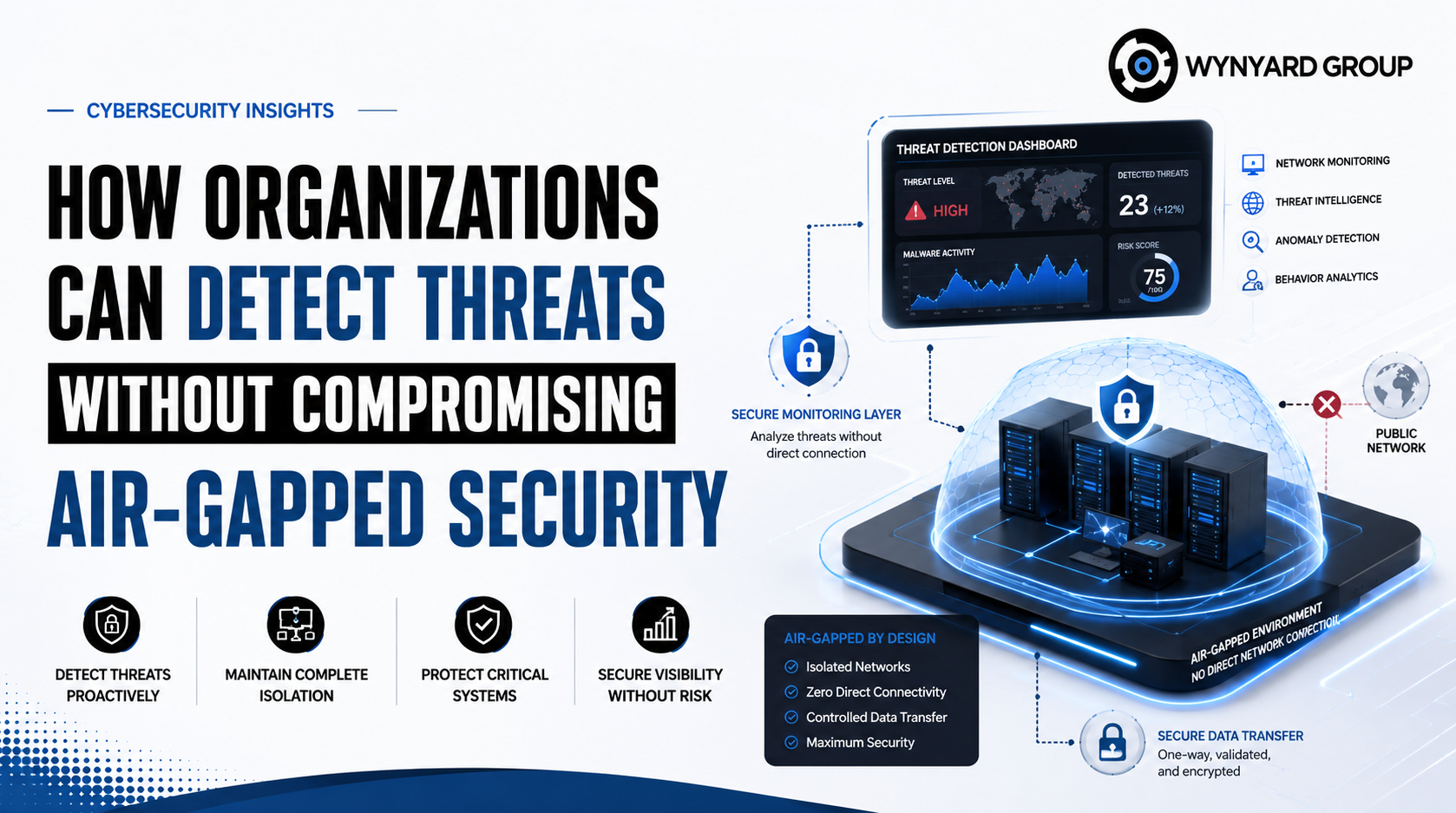
Security professionals throughout Southeast Asia face a contradiction that keeps threat analysts awake all late at night. A measure that was intended to guard vital infrastructure by separating networks from external interference can also make security personnel blind to the activities happening within these networks. Systems that are air-gapped in Jakarta’s power substations, Singapore’s transportation hubs, as well as Manila’s government structures are constructed to be inaccessible. But unreachable does not mean unthreatened.
What organizations are contemplating at present isn’t whether they are secured by air-gapped networks. The question is whether they are able to keep their networks secure while giving security personnel the information they need to react quickly.
The Blind Spot Inside Air-Gapped Networks
The reputation of air-gapped networks is built on. Through physically separating critical networks from the public Internet and ensuring that organizations operating in high-risk industries like energy, water, and defense establish an impervious boundary that conventional attacks cannot overcome. Human error remains the top way dangers are still able to enter: USB drives smuggling malware, contractors who are unaware of the gaps, and maintenance laptops that create weaknesses.
If a threat does cross this physical line, and the absence of outside monitoring channels allows it to remain undetected for weeks or even months. The organizations that operate in Jakarta as well as Manila have discovered that without the ability to recognize patterns promptly, the time to detect a threat can range between a few minutes and weeks. In the case of critical infrastructure companies, the gap in time is unacceptable.
The standard solution is to increase the number of manual inspections and more remote SIEM tools, or to accept less visibility to reduce security. All of these methods are ineffective. They also do not provide security professionals with the immediate information they require.
What Data Diodes Actually Do
Data diodes are electronic devices that run on hardware devices that have two distinct circuits: one for sending only, and one for receiving only. This makes sure that a physical space is created between two interconnected networks, keeping intrusive threats from entering the structure of the networks.
The real-world application of this design is huge. Security events, telemetry logs, SCADA outputs, as well as network behavior information, can transfer outward from the secured environment into the analytics system. The data does not flow back. Inbound channels are not available. No attack route can be reversed.
If combined with the latest cybersecurity threat analysis and hardware-enforced one-way communications, this transforms into something much more effective than passive security controls. Analytics software allows continuous outbound data coming that comes from secure systems without allowing a return route that can pose a threat. It is this way that intelligence agencies can observe, analyze the situation, and react quickly even in extremely classified settings.
Where NVMS Fits Into the Picture
The surveillance infrastructure is usually viewed as an independent concern in cybersecurity. This separation can pose risks. Wynyard Group’s Cyber Threat Analytics provides a complete solution by combining four steps: NVMS, Data Diode, Deception Technology, and Distributed SIEM Solution.
Cybersecurity threat analysis based on NVMS data generates correlating capabilities that change the way organisations identify, analyze, and address security-related incidents. Monitoring in real-time of traffic on the network for video management will detect if cameras are intentionally impaired, or when data leakage that is unusual is detected through surveillance systems, or when patterns of device authentication hint at a compromised credential.
NVMS platforms store huge amounts of sensor and video data that are collected from critical places, including ports, airports, and government infrastructure. Sending this data in a secure manner to analytics centers has historically presented a major challenge. Data Diode Cyber threat Analytics solves this issue by providing secure transmission of video with no risk of data leakage, which allows real-time analysis as well as consolidated monitoring of threats in multiple locations, without jeopardizing the security of the network.
For those who manage distributed environments in Thailand’s petrochemical plants as well as Indonesia’s utility network, the consolidated solution eliminates the hassle of running separate security systems across all sites.
Practical Application Across Southeast Asia
Singapore’s grid providers, who oversee high-density urban infrastructure as well as utilities in Malaysia, and manage distributed generation assets, are both able to benefit from an inbound-access-free policy. This architecture lets organizations collect meaningful operational data without establishing a path that adversaries can use to gain access in reverse.
The Thai government’s cybersecurity efforts, as well as Indonesia’s critical infrastructure security initiatives, are increasingly including data diode networks to provide the highest level of security. This shift is a reflection of broader acceptance that visibility of threats and the isolation of networks are not separate purposes. If they are built in the right way and designed, they complement each other.
Wynyard Group developed its Data Diode Cyber threat Analytics platform to address the challenge. The NVMS platform that powers the solution was designed specifically for situations where the reliability of a system is not a matter of debate, and the expense of downtime outweighs the savings from the prevention.
Security That Sees Without Exposing
The businesses that can handle cybersecurity threats with the most effectiveness over the coming years do not have the most secluded networks. They’re the ones who have discovered ways to ensure complete visibility in those networks while avoiding the weaknesses isolation was intended to protect against.
Critical infrastructure managers operating in Vietnam or a related defense facility located in the Philippines are able to monitor technology operational networks, integrate threat intelligence feeds, and control analytics workflows in an air-gapped, high-security and high-security environment, and without compromise on privacy.
Wynyard Group considers this to be an ongoing effort instead of a set-and-forget deployment. Companies that wish to bridge the gap between security that is air-gapped and actionable threat intelligence must consider whether their present structure is able to support both, since in the current security landscape that is affecting Southeast Asia right now, it is costly to choose one, or the other option is simply too expensive.